New Jersey is a northeastern U.S. state with some 130 miles of Atlantic coast. Jersey City, across the Hudson River from Lower Manhattan, is the site of Liberty State Park, where ferries embark for nearby Ellis Island, with its historic Immigration Museum, and the iconic Statue of Liberty. The Jersey Shore includes notable resort towns like historic Asbury Park and Cape May, with its preserved Victorian buildings.
Abbreviation: NJ
Capital: Trenton
Temperature: 87 degrees, mostly sunny
Time: 2:00 PM
Nickname:
Abraham Browning of Camden is given credit for giving New Jersey the nickname the Garden State. According to Alfred Heston's 1926 two-volume book Jersey Waggon Jaunts, Browning called New Jersey the Garden State while speaking at the Philadelphia Centennial exhibition on New Jersey Day (August 24, 1876).
Motto:
Liberty and Prosperity
The state motto of New Jersey is “Liberty and Prosperity.” Like a number of other states, New Jersey's state motto was not officially adopted. It has gained acceptance as the unofficial state motto because it is a feature of the state seal.
Population: 9.262m (PA 12.8m)
Size: 8,729 square miles (PA 46,000 sq m)
Cost of living: $64,463 (PA $49,040)
Minimum wage: $15.13 (PA $7.25)
Statehood: December 18, 1787 (it was one of the original 13 colonies)
State Flag:
Three plows on the shield honor the state's agricultural tradition. The helmet above the shield faces forward, an attitude denoting sovereignty (fitting for one of the first governments created under the notion that the state itself is the sovereign). The crest above the helmet is a horse's head. The supporting female figures are Liberty and Ceres (Roman goddess of grain - a symbol of abundance). Liberty carries the liberty cap on her staff and Ceres holds a cornucopia filled with harvested produce; they are supported by a banner that reads "Liberty and Prosperity"
State Bird:
American Goldfinch
State Flower:
Common Blue Violet
State Tree:
Northern Red Oak
State Mammal:
Horse
Horses have been important to New Jersey for over two centuries, and are vital to the state's economy, culture, landscape, and agriculture. New Jersey has more horses per square mile than any other state, and the equine industry contributes over $600 million to the state's economy, creating around 13,000 jobs. The industry is made up of two sectors: pleasure horses and race horses.
State Quarter:
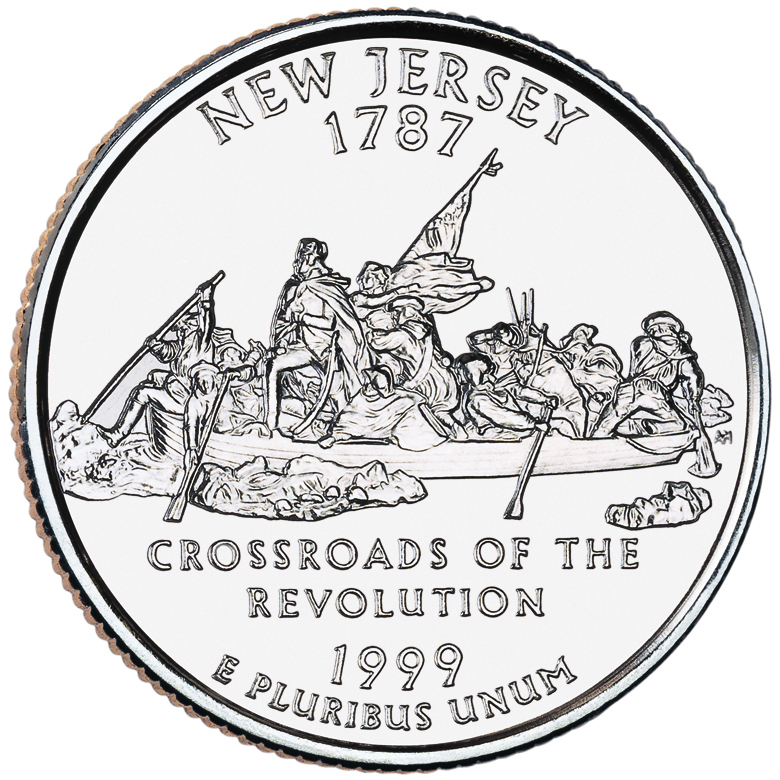
The New Jersey State Quarter, commemorates New Jersey's role in the Revolutionary War. The quarter's design depicts General George Washington leading his troops across the Delaware River to Trenton, New Jersey on Christmas night in 1776. The coin also features the words "Crossroads of the Revolution" printed on the bottom, a reference to New Jersey's central location during the war.
Missouri is a state in the Midwestern region of the United States. Missouri shares a border with 8 other states: it borders Iowa to the north, Illinois, Kentucky and Tennessee to the east, Arkansas to the south and Oklahoma, Kansas, and Nebraska to the west. Abbreviation: MO Capital: Jefferson City Temperature: 76 degrees, thunderstorms Time: 1:00 (CST, 1 hour behind us) Nickname: The 'Show-Me State' Missouri has long been known as the Show Me state, but the origins of that nickname aren’t entirely clear. Perhaps the best-known story involves a Missouri representative named Willard Duncan Vandiver. After a tour of the Philadelphia Navy Yard in 1899, the congressman was invited to a meeting of Philadelphia ’s Five O’Clock Club, a gathering place for the city’s political and business elite. Vandiver hadn’t packed formal attire for the trip, and, when it was his turn to address the tuxedo-clad crowd, he jokingly accused Rep. John Hull of Iowa ...
North Carolina is a state in the Southeastern region of the United States . It is bordered by Virginia to the north, the Atlantic Ocean to the east, South Carolina to the south, Georgia to the southwest, and Tennessee to the west. Abbreviation: NC Capital: Raleigh Temperature: 59 degrees, mostly sunny Time: 2:00 PM (same time zone) Nickname: "Tar Heel State" In the 1770s, North Carolina produced a lot of tar to manufacture ships. Most tar production comes from small farms that also produce livestock and crops. North Carolina was and is a leading producer of tar, turpentine, rosin, and pitch. ‘Tar Heel’ was a term used for workers who went barefoot to collect sap used for the production of tar and pitch. It was a derogatory term associated with low-class workers. During the Civil War, soldiers began to call themselves ‘tar heels’ and completely annulled the shame and humiliation associated with this moniker. Today, North Carolina is known the world over as the ‘T...
















Comments
Post a Comment