Montana is a western state defined by its diverse terrain ranging from the Rocky Mountains to the Great Plains. Its wide-open spaces include Glacier National Park, a vast wilderness preserve that passes into Canada. The park’s many snow-capped peaks, lakes and alpine hiking trails are showcased along its famed Going-to-the-Sun Road, stretching 50 miles.
Abbreviation: MT
Capital: Helena
Temperature: 64 degrees, mostly cloudy
Time: 12:00 (MT, 2 hours behind us)
Nickname: Big Sky Country
Montana is known as "Big Sky Country" because of its unobstructed skyline, which can sometimes seem to overwhelm the landscape. The nickname originated in 1962 during a promotion for the Montana State Highway Department, and is credited to author A.B. Guthrie, Jr.'s 1947 western novel The Big Sky. The novel accurately depicted the state's untamed landscape, which helped Montana associate with the name "Big Sky".
Population: 1.1 million (PA 12.8m)
Size: 147,040 square miles (PA 46,000)
You can fit the states of Delaware, Pennsylvania, New York, Maryland, Virginia and the District of Columbia into Montana.
Cost of living: $47,887 (PA $49,040)
Minimum wage: $10.30 (PA $7.25)
Statehood: November 8, 1889
State Flag:
The Montana state flag's design includes the state seal in the center, which depicts Montana's natural beauty, farming, and mining history. The blue field of the flag features a sun over snowy mountains, forests, cliffs, and the Great Falls of the Missouri River. The seal also includes a plow, shovel, and pick, which represent Montana's agriculture and mining past and present. The state motto, "Oro y Plata" (Spanish for "Gold and Silver"), appears on a ribbon below the tools. The ribbon is a reference to the state's mining history, when Montana was nicknamed the "Treasure State".
Ponderosa pine is the state tree of Montana. Ponderosa occur in the warm and dry forest and can live for hundreds of years and become very large and beautiful trees. The trees are intolerant meaning they require full sunlight to grow well.
State Mammal:
Grizzly Bear (Ursus arctos horribilis)
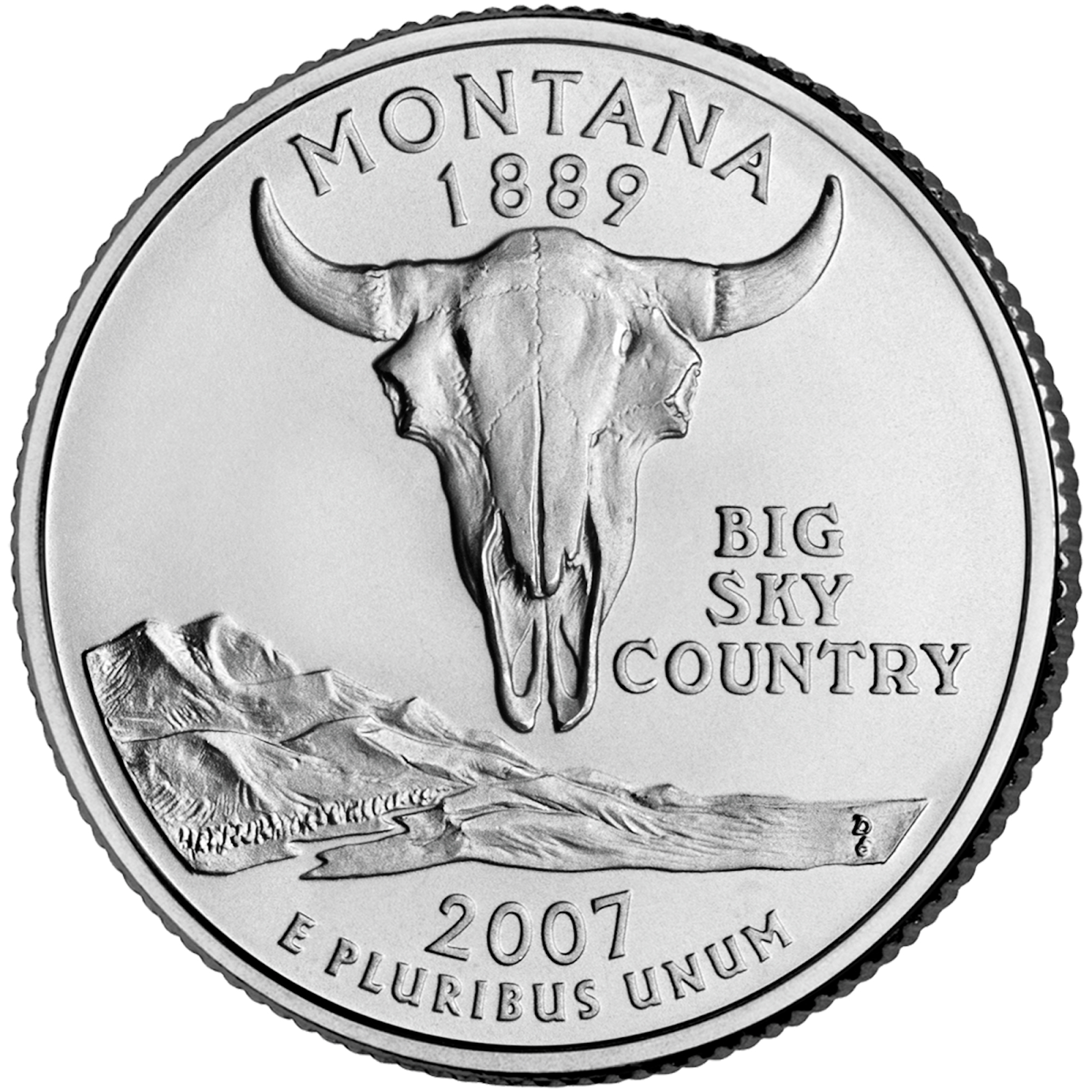
State Quarter:
The diversity of terrain, with mountains, plains and rivers, are seen below the skull of a bison, a powerful and sacred symbol of the culture and traditions of Montana's eight Tribal Nations, that is still commonly seen throughout this sprawling state.
Missouri is a state in the Midwestern region of the United States. Missouri shares a border with 8 other states: it borders Iowa to the north, Illinois, Kentucky and Tennessee to the east, Arkansas to the south and Oklahoma, Kansas, and Nebraska to the west. Abbreviation: MO Capital: Jefferson City Temperature: 76 degrees, thunderstorms Time: 1:00 (CST, 1 hour behind us) Nickname: The 'Show-Me State' Missouri has long been known as the Show Me state, but the origins of that nickname aren’t entirely clear. Perhaps the best-known story involves a Missouri representative named Willard Duncan Vandiver. After a tour of the Philadelphia Navy Yard in 1899, the congressman was invited to a meeting of Philadelphia ’s Five O’Clock Club, a gathering place for the city’s political and business elite. Vandiver hadn’t packed formal attire for the trip, and, when it was his turn to address the tuxedo-clad crowd, he jokingly accused Rep. John Hull of Iowa ...
New Jersey is a northeastern U.S. state with some 130 miles of Atlantic coast. Jersey City, across the Hudson River from Lower Manhattan, is the site of Liberty State Park, where ferries embark for nearby Ellis Island, with its historic Immigration Museum, and the iconic Statue of Liberty. The Jersey Shore includes notable resort towns like historic Asbury Park and Cape May, with its preserved Victorian buildings. Abbreviation: NJ Capital: Trenton Temperature: 87 degrees, mostly sunny Time: 2:00 PM Nickname: Abraham Browning of Camden is given credit for giving New Jersey the nickname the Garden State . According to Alfred Heston's 1926 two-volume book Jersey Waggon Jaunts, Browning called New Jersey the Garden State while speaking at the Philadelphia Centennial exhibition on New Jersey Day (August 24, 1876). Motto: Liberty and Prosperity The state motto of New Jersey is “ Liberty and Prosperity .” Like a number of other states, New Jersey's state motto was not offici...
New Hampshire, a U.S. state in New England, is defined by its quaint towns and large expanses of wilderness. In the north, White Mountain National Forest is known for winter sports areas and Mt. Washington, the region’s highest peak, with a cog railway to its summit. Also in the White Mountains are moose, black bears and part of the Appalachian Trail. Abbreviation: NH Capital: Concord Temperature: 88 degrees, sunny Time: 11:00 AM Nickname: The state is nicknamed “The Granite State” because granite from the state was supplied for building structures mainly in Boston and Washington D.C., and many other small towns. The pink colored Conway Granite and the gray colored Concord Granite are two granites that were quarried locally and shipped widely. The granites got their names from the towns in which they were first quarried. Motto: Live Free or Die Adopted by the state in 1945. It is possibly the best-known of all state mottos, partly because it conveys an assert...












Comments
Post a Comment